
Rumours travel fast during Super Bowl season. And one of the biggest Super Bowl rumors of this year was Elon Musk dropping millions to buy ad spots for DOGE. Apparently, he bought five commercials and was taking a political swing on the biggest TV state in the US. This all sounds very outrageous. But given that it’s Musk, it also sounds wildly believable. After all, he does have a history of making headlines for stunts no one sees coming.
Now it’s been months since the Super Bowl, so we can finally look at this with some clarity and find out what happened.
Did Elon Musk Buy Super Bowl Ads?
No. Multiple fact-checking sites, including Reuters and PolitiFact, have confirmed Elon didn’t buy ad time for the Super Bowl. The game was in February, and months have passed, and there’s not a single DOGE commercial to be found online or in the broadcast archives.
The claim originated online, where people posted about it, presenting it as news with fake pictures and claiming he had spent millions on multiple ads. From there, it was shared, reshared, and stripped of the “satire” context until it looked like a real news article. By the time the fact checkers weighed in, the rumor had already spread, but the truth is simple. There were no DOGE ads at Super Bowl 2025 because Elon did not buy them.
Where Did The Rumor About Elon Musk Buying Super Bowl Ads Come From?
It started on Facebook, with posts claiming he spent millions to air multiple commercials for his “Department of Government Efficiency (DOGE)” during the game. Some of these posts were satire, but that context got lost as they were shared. There were more posts with screenshots and out-of-context quotes, where it was repeated as fact. By the time fact-checkers got involved, the story had already taken off despite having no evidence to back it up.
How Did The Elon Musk Super Bowl Ad Rumour Spread?
After the initial Facebook posts, the claim was shared across multiple groups and pages, often without the original context and satirical framing. From there, it jumped to other platforms like Reddit, X, and TikTok, where screenshots and paraphrased versions made it seem more real. Musk’s high profile, the political angle of the ads, and the spectacle of the Super Bowl made it clickbait, so people shared it without checking the source. Within days, it had the reach of a breaking news story, despite being completely false.
Debunking the “$40 Million Elon Musk Super Bowl Ad” Rumour
The image that fueled the claim shows Elon Musk sitting at a table with two other people, smiling and holding up a nearly empty bottle of bourbon. In the shot, a caption reads: “Elon Musk spent 40 million of his own money to buy 5, 30 second long commercial slots during Super Bowl where he’s gonna list all the corruption DOGE has found so far.”
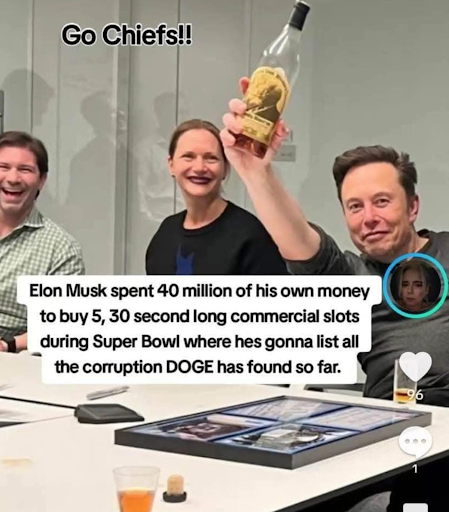
At first glance, it looks like a casual meeting room photo, and that’s precisely what it is. There’s no evidence that this picture was related to any Super Bowl ad deal. According to the Daily Mail, this is actually a picture from 2022, where Elon was drinking bourbon with his colleagues while celebrating buying Twitter. And the caption wasn’t part of the original image; it was added later and turned it into a meme-style post that looks like a news snippet.
Fact-checkers at Reuters and PolitiFact found no record of Musk or any Musk-owned company buying Super Bowl ad time in 2025. Ad databases and trackers that catalog every slot sold during the broadcast show no DOGE or Musk-linked commercials. The posts that went viral were traced back to Facebook and TikTok, where the image was shared without any verification.
In reality, the only Musk-related appearance during the game was a brief cameo for SpaceX’s Starlink in a T-Mobile commercial. Not a political ad and not something directly paid for by Musk. The $40 million DOGE Super Bowl blitz never happened.
Why Doesn’t Tesla Advertise on Run TV Commercials?
Tesla has never done traditional advertising. The company built its brand through press coverage, product launches, social media, and word of mouth instead of paying for prime-time TV slots. That’s because Elon Musk has always said good products sell themselves.
When other car makers spend millions on Super Bowl ads, Tesla is absent. Musk has said those budgets are better spent on engineering and production than on one night of expensive airtime. Until recently, Tesla didn’t even have a marketing team.
But Elon doesn’t avoid advertising entirely for all his ventures. In 2025, one of his other companies, SpaceX, appeared indirectly during the game through a T-Mobile ad for Starlink satellite internet. But Tesla itself has never bought a Super Bowl slot, which is why the $40 million DOGE ad felt so out of place.
How Much Does a 30-Second Super Bowl Ad Spot Cost?
In 2025, a 30-second Super Bowl ad costs between $7 million and $8 million. That’s the highest it’s ever been, and it’s been going up almost every year. In 2010, it was around $3 million. Go back to the early ’90s, and you could get it for under a million.
It’s not just inflation, it’s about the size and type of audience. The Super Bowl draws over 100 million viewers in the US alone, with millions more tuning in through streaming. It’s one of the few events where people actually pay attention to the commercials, discuss them, and share them afterwards. For advertisers, that kind of reach and engagement is almost impossible to buy anywhere else.
Now, is it worth it? For some brands, yes. A great ad can generate weeks of free publicity online, millions of extra views on social media, and even win awards. For others, especially smaller companies, the cost is hard to justify unless the creative is strong enough to break through the noise. The slot buys attention, but what you do with that time determines if it’s money well spent.
Where to Find Super Bowl Ads After the Game?
The Super Bowl is the only time of year when people actually want to watch commercials, but not everyone catches them live. Maybe you were in the kitchen refilling snacks, maybe you don’t even watch football, or maybe you’re outside the US and can’t stream the game easily. The good news is, every ad worth talking about ends up online within hours, and in some cases, even before kickoff.
The easiest place to start is YouTube AdBlitz. It’s a one-stop playlist of every central Super Bowl spot, usually organized so you can binge-watch them back-to-back without digging around. Some brands even post extended cuts there.
To see what a specific company is doing, check their official YouTube channels or social media pages. Big brands treat these ads like events, so they’ll pin them to the top of their feeds and sometimes drop behind-the-scenes clips.
The NFL’s website and social channels also round up the most popular game-day ads, usually with some basic write-ups so you can see what everyone’s talking about.
And finally, a lot of brands “leak” their spots in the week leading up to the game. It’s just a marketing tactic to build hype.
Wrapping Up
The Super Bowl is one of the few places where ads feel like part of the show instead of an interruption. The good ones become cultural moments. People seek them out themselves, share them, and quote them for years. That’s rare in advertising, and that’s why brands are willing to pay millions for just 30 seconds of airtime.
Everywhere else, it’s a different story. Most ads are repetitive, intrusive, and forgettable. For those, there’s no reason to sit through them when you can set up one of the best ad blockers of 2025. They keep the annoying ads out of your browsing so you only see the ads worth your time.