
If you are asking whether uBlock Origin is dead, the honest answer is: it is dead on Chrome, but very much alive everywhere else. In June 2025 Google finished switching Chrome over to a new extension system called Manifest V3, and the classic, full-power uBlock Origin simply cannot run under those rules anymore. So if you opened Chrome one day and found your ad blocker greyed out, disabled, or gone, you were not imagining it. But “removed from Chrome” is not the same as “gone for good,” and this guide walks through exactly what happened, what still works, and the cleanest way to get your ad blocking back.
The short version
- Is uBlock Origin dead? Only on Chrome (and Chromium browsers that followed Chrome’s lead). The project itself is still actively developed.
- On Firefox the original, full-strength uBlock Origin still works perfectly and is not going anywhere.
- On Chrome your options are uBlock Origin Lite (a slimmed-down version), switching browsers, or moving ad blocking outside the browser with a system-level app like AdGuard.
- Your filters did not break. Chrome’s new rules broke the kind of extension uBlock Origin is. Nothing you did caused it.
What actually happened to uBlock Origin
Chrome extensions used to run on a framework called Manifest V2. uBlock Origin used that framework to do powerful things: filter network requests in real time, run unlimited filter rules, and use dynamic filtering to fight anti-adblock scripts. Google has now replaced Manifest V2 with Manifest V3, and Manifest V3 deliberately limits exactly those abilities. It caps how many filter rules an extension can use and removes the real-time request blocking that uBlock Origin depends on.
Because of that, the original uBlock Origin was never going to survive on Chrome in its full form. Through 2024 and into 2025 Chrome began disabling Manifest V2 extensions automatically, and by mid-2025 the classic uBlock Origin was effectively switched off for Chrome users. That is the moment most people noticed their ad blocker “die.” For a deeper look at the technical change, see our explainer on the Manifest V3 impact on ad blockers.
So is uBlock Origin really dead, or not?
It depends entirely on which browser you use. Here is the real status, browser by browser, so there is no confusion:
- Google Chrome: the original uBlock Origin is dead here. Chrome will not run it. You can install uBlock Origin Lite instead, but it is weaker.
- Mozilla Firefox: fully alive. The complete uBlock Origin runs at full strength, and Mozilla has publicly committed to keeping the features it needs.
- Microsoft Edge: on borrowed time. Edge is Chromium-based and is moving toward the same Manifest V3 limits, so it is a temporary refuge at best.
- Brave: Brave has its own built-in blocker, so it is less affected, though the uBlock Origin extension itself faces the same Chromium limits.
- Opera and other Chromium browsers: same direction as Chrome, just on a slightly different timeline.
So the headline “uBlock Origin is dead” is really shorthand for “uBlock Origin is dead on Chrome.” The developer, Raymond Hill, is still actively maintaining the project. It simply lives on Firefox now, plus the new Lite version for Chromium.
Are all ad blockers affected, or just uBlock Origin?
This is the part most people get wrong. The Manifest V3 change affects every Chrome ad blocker, not just uBlock Origin. AdBlock, Adblock Plus, Ghostery, and the rest all run under the same new limits now, so none of them can match what the old uBlock Origin did on Chrome. uBlock Origin just felt the loss most because it was the most powerful to begin with, so it had the most to lose.
The tools that are not affected are the ones that do not rely on a Chrome extension at all: the original uBlock Origin on Firefox, browsers with built-in blocking like Brave, and system-level apps like AdGuard that filter outside the browser. That is the key distinction to keep in mind as you choose, because swapping one capped Chrome extension for another capped Chrome extension does not really solve the problem.
Why did Google kill uBlock Origin on Chrome?
Google’s official reason for Manifest V3 is security, privacy, and performance. The argument is that extensions with deep, real-time access to your web traffic are a risk, and that limiting them protects users from badly written or malicious extensions. There is some truth to that.
The uncomfortable counterpoint is that Google makes the overwhelming majority of its money from advertising, and the same rules that “protect” users also happen to weaken the most effective ad blockers on the most popular browser in the world. Whatever the motive, the practical result is the same: the powerful version of uBlock Origin cannot run on Chrome, and that is not going to be reversed.
Is uBlock Origin Lite the same thing?
No, and this trips a lot of people up. uBlock Origin Lite (uBOL) is a separate, newer extension by the same developer, built specifically to fit inside Chrome’s Manifest V3 rules. It is a genuine, trustworthy product, but it is deliberately lighter. It loses dynamic filtering and the deep per-site control that made the original so strong against tricky sites and anti-adblock walls.
uBOL also has a setting most people never touch: a filtering mode (Basic, Optimal, or Complete). Left on Basic it blocks far less than the original did. Set to Optimal it gets much closer on everyday sites. If you want the full breakdown, we compared them side by side in uBlock Origin vs uBlock Origin Lite. The short takeaway: uBOL is good, but it is not a one-to-one replacement for what you lost.
What to use now that uBlock Origin is gone from Chrome
You have three realistic paths, and the best one depends on whether you are willing to switch browsers and how strong you want your blocking to be.
Option 1: Stay on Chrome and add a system-level blocker (strongest)
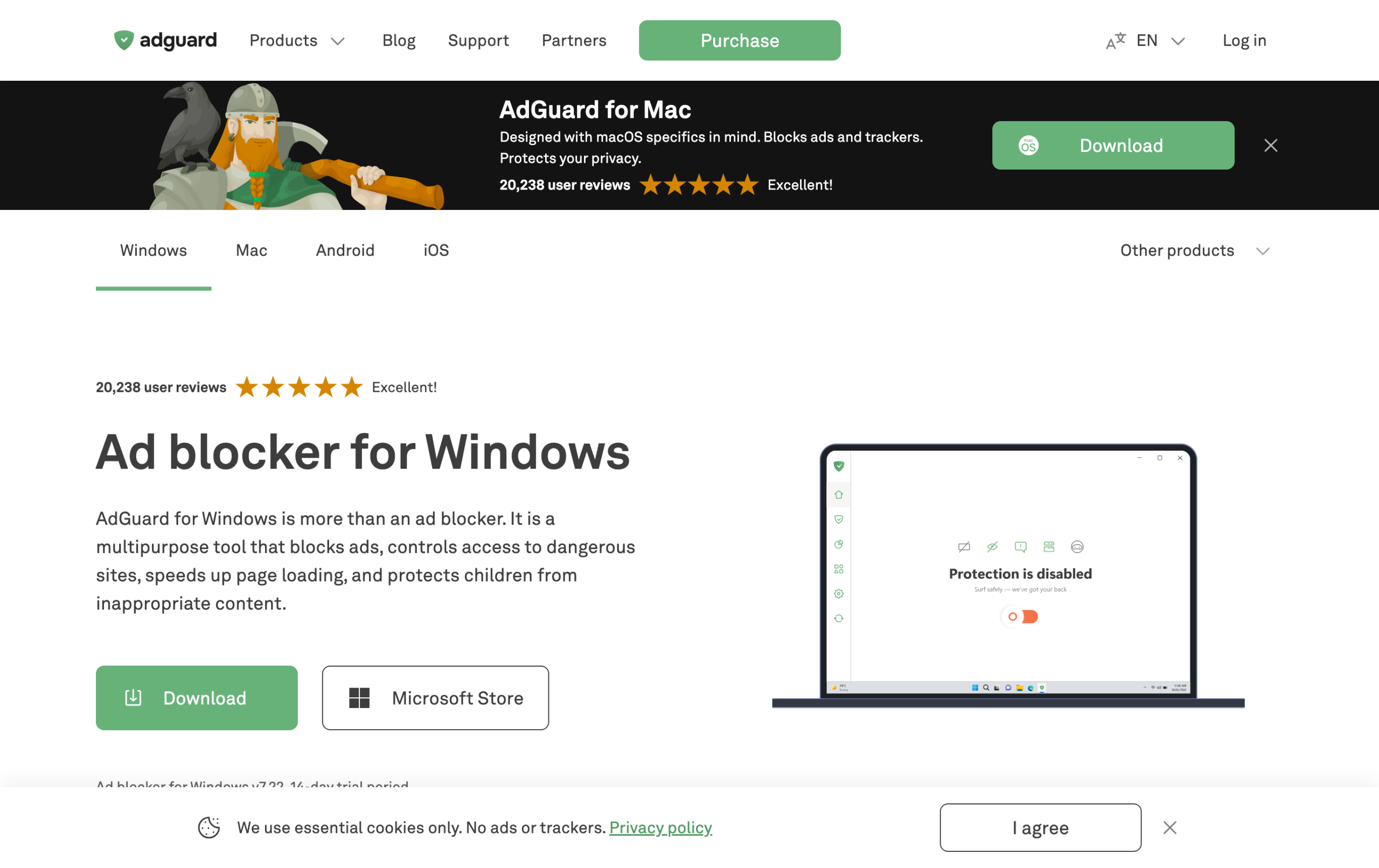
The most complete fix is to stop relying on a browser extension at all. The AdGuard desktop app filters all of your traffic at the system level, which means Chrome’s Manifest V3 limits simply do not apply to it. You keep using Chrome exactly as before, but you get unlimited filter rules, real-time blocking, and ad blocking in every browser and app on your device, YouTube included. In our own testing it scored a perfect 100/100, where uBlock Origin Lite on Chrome manages 96/100. It is a paid app, but it is inexpensive, and the code CHECKADBLOCK30 takes 30% off.
Option 2: Switch to Firefox and keep the real uBlock Origin (free)
If you love uBlock Origin specifically and do not want to pay for anything, the simplest move is to switch to Firefox. The full, unrestricted uBlock Origin runs there exactly as it always did, and Mozilla has said it intends to keep supporting the features it relies on. You import your bookmarks, install the extension from the Firefox add-ons store, and you are back to full-strength blocking for free.
Option 3: Stay on Chrome with uBlock Origin Lite (free, lighter)
If you want to stay on Chrome and stay free, install uBlock Origin Lite and set it to Optimal mode. It is a real step down from the original, but on everyday websites it does a respectable job. Just go in with realistic expectations, especially around YouTube and sites with aggressive anti-adblock scripts.
uBlock Origin replacement: quick comparison
| Option | Cost | Strength | Switch browser? | Best for |
|---|---|---|---|---|
| AdGuard app | Paid (30% off code CHECKADBLOCK30) | Strongest | No | Staying on Chrome with no compromise |
| Firefox + uBlock Origin | Free | Strong | Yes | Keeping the real uBlock Origin |
| uBlock Origin Lite | Free | Medium | No | Free and simple on Chrome |
| Brave browser | Free | Strong (built in) | Yes | A clean browser with blocking baked in |
If your main frustration is YouTube ads creeping back in, that is the hardest case for any Chrome extension. Our guide to the best ad blockers for YouTube goes deeper, but the short answer is that a system-level app or Firefox handles YouTube far more reliably than uBOL.
What about a blocker plus a VPN?
If you also care about privacy, there is a fourth angle worth knowing about. A network-level tool like Surfshark CleanWeb blocks ads and trackers at the DNS level while also giving you a full VPN. It will not match a dedicated app like AdGuard rule for rule, but if you were going to pay for a VPN anyway, getting ad blocking bundled in is a sensible two-for-one.
Will uBlock Origin ever come back to Chrome?
Almost certainly not in its original form. Manifest V3 is now the foundation of Chrome’s extension system, and the whole point of the change was to remove the capabilities uBlock Origin used. Google is not going to roll that back. The most you will get on Chrome is uBlock Origin Lite, which is built to live within the new limits, not around them. That is why, if you want a fix you will not have to revisit, the durable choices are moving outside the browser (AdGuard) or moving to a browser that protects these features (Firefox).
A quick timeline of how we got here
If you want the short history of why your ad blocker vanished, it played out over several years rather than overnight:
- 2018 to 2019: Google first proposed Manifest V3, and ad-blocker developers immediately warned it would cripple tools like uBlock Origin.
- 2022 to 2023: Manifest V3 was finalized and the timeline to retire Manifest V2 was set, despite ongoing pushback.
- 2024: Chrome began rolling out warnings and started disabling Manifest V2 extensions for more and more users.
- 2025: the rollout completed, and the original uBlock Origin was effectively switched off on Chrome. This is when most people noticed.
- Now: on Chrome you get uBlock Origin Lite or a different tool. On Firefox the original carries on untouched.
What this means for your privacy
Ad blockers do more than hide ads, they also block trackers that follow you around the web. So when the original uBlock Origin stopped working on Chrome, a lot of people quietly lost a chunk of their tracker protection too, often without realizing it. That is the real reason this change matters beyond the annoyance of seeing ads again. Whatever route you choose, picking a replacement that also blocks trackers (the original on Firefox, a system-level app like AdGuard, or a privacy-focused tool) restores that protection rather than leaving you more exposed than you were before.
Frequently asked questions
Is uBlock Origin dead in 2026?
It is dead on Google Chrome, where Manifest V3 no longer allows it to run. It is still fully alive and maintained on Firefox, and the developer also offers uBlock Origin Lite for Chromium browsers.
Did uBlock Origin get discontinued?
No. The project is not discontinued. What happened is that Chrome stopped supporting the type of extension it is. uBlock Origin continues on Firefox, and uBlock Origin Lite was created to work under Chrome’s new rules.
Why did my uBlock Origin stop working?
Because Chrome disabled Manifest V2 extensions. Nothing on your end caused it. You can switch to Firefox to keep the original, install uBlock Origin Lite, or use a system-level app like AdGuard.
What is the best replacement for uBlock Origin?
For staying on Chrome with the strongest blocking, the AdGuard desktop app. For keeping the real uBlock Origin for free, switch to Firefox. For a free Chrome option, uBlock Origin Lite on Optimal mode.
Is uBlock Origin Lite as good as the original?
Not quite. It is lighter by design and loses dynamic filtering and deep per-site control. On Optimal mode it does well on everyday sites, but it is weaker on YouTube and against anti-adblock walls.
Related reading: uBlock Origin not working on Chrome? What to use in 2026, uBlock Origin vs uBlock Origin Lite, and our full AdGuard review.